
Achilles Tendon Repair Rehab for Athletes: How to Return to Sport Stronger
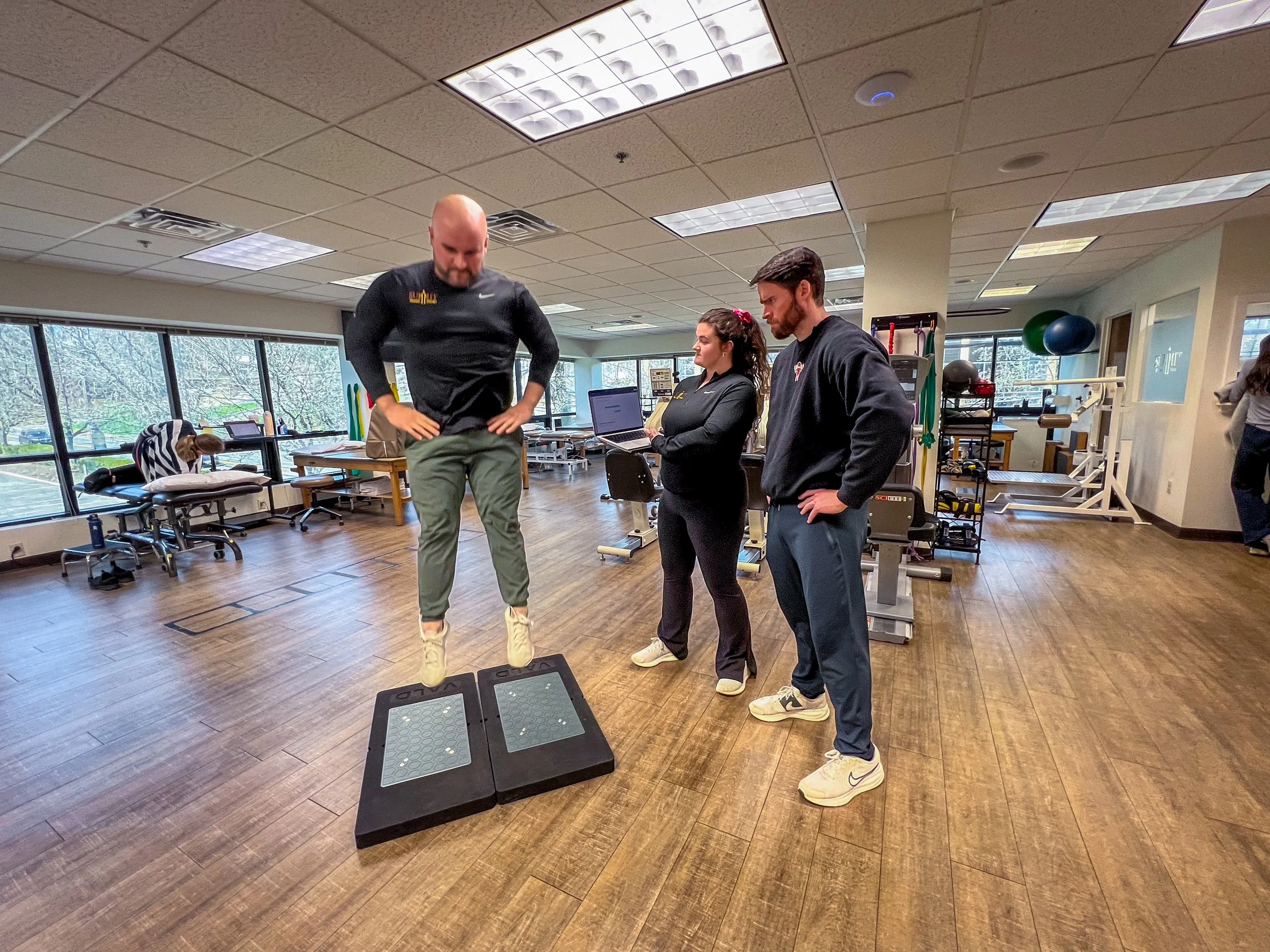
For an athlete, Achilles tendon repair is not simply about healing the surgical site or walking without a boot. The real goal is restoring the strength, power, speed, and confidence required to run, jump, cut, and compete.
This is where advanced Achilles tendon repair rehabilitation matters.
An athlete may feel good during everyday activities while the repaired leg still lacks calf strength, heel-rise height, power, or the ability to tolerate repeated explosive movements. Returning to sport based only on time after surgery can leave important deficits unaddressed.
At Summit Physical Therapy, Achilles repair rehab follows a progressive, criteria-based plan. Each phase builds the foundation for the next, and objective testing helps determine when an athlete is ready to advance.
Important: The timing of weight bearing, range of motion, strengthening, running, and jumping must follow the surgeon's specific protocol. Surgical technique, tendon quality, wound healing, and individual risk factors can change the progression.
What Is the Biggest Mistake Athletes Make After Achilles Repair?
The biggest mistake is confusing permission to begin an activity with readiness to tolerate that activity.
Being cleared to walk, jog, jump, or practice does not mean the repaired leg has recovered the physical qualities needed to perform those activities repeatedly. A return-to-sport decision should consider more than the number of weeks since surgery.
Before unrestricted sport, athletes need to rebuild:
Ankle and foot mobility
Calf strength through the available range
Single-leg control
Heel-rise height and endurance
Lower-body power
Plyometric and change-of-direction ability
Sport-specific conditioning and durability
Rehabilitation should expose the Achilles to progressively greater demands while monitoring symptoms, movement quality, and recovery between sessions.
Phase 1: Protect the Repair and Control Pain and Swelling
Early rehabilitation focuses on protecting the repaired tendon and allowing the incision to heal. The boot position, weight-bearing status, and permitted ankle motion are determined by the surgeon's protocol.
Physical therapy may include:
Education on safe mobility and activity modification
Swelling and pain management
Gait training with the appropriate assistive device
Exercises for the hip, knee, and core
Safe activation of the foot and lower leg when permitted
Monitoring for wound concerns or an unexpected increase in symptoms
Early rehabilitation is not passive, but it must be appropriately controlled. Doing too much too soon may irritate the ankle, alter walking mechanics, or expose the healing tendon to more stress than it is ready to tolerate.
Phase 2: Restore Ankle Mobility Without Overstretching the Tendon
Ankle mobility is gradually restored according to the surgeon's restrictions. The goal is to regain the motion needed for normal walking and athletic movement without aggressively stretching the healing Achilles.
This distinction matters because excessive tendon elongation can reduce the calf's ability to generate force through its full range. Rehabilitation must balance mobility restoration with protection of the repair.
Treatment may address:
Ankle motion within the permitted range
Foot and toe mobility
Knee and hip mobility
Scar and surrounding soft-tissue mobility after the incision has healed
Progressive normalization of walking mechanics
The objective is not to force range of motion as quickly as possible. It is to restore useful movement while maintaining the mechanical advantage of the repaired tendon and calf complex.
Phase 3: Rebuild Neuromuscular Control and Normal Movement
After immobilization, the athlete often unloads the repaired side and develops compensations. These may remain even after pain improves.
Neuromuscular training helps the athlete regain control of the entire leg during:
Standing and walking
Weight shifts
Squatting and hinging
Step-ups and step-downs
Single-leg balance
Landing and deceleration tasks later in rehab
This phase is about more than balance on an unstable surface. The athlete must learn to accept force through the foot and ankle, control the knee and hip, and move without avoiding the repaired side.
Phase 4: Restore Calf Strength Through the Full Range
Calf strength is one of the most important—and often most persistent—limitations after Achilles tendon repair. Rehabilitation should train both major plantar-flexor muscles:
The gastrocnemius, emphasized with the knee straighter
The soleus, emphasized with the knee bent
The soleus is especially important for running because it helps absorb and produce large forces during stance. Strengthening may progress from protected isometrics and seated calf work to bilateral heel raises, assisted single-leg heel raises, full single-leg heel raises, and eventually heavy resistance.
Quality matters. An athlete who completes repetitions by bending the knee, shifting to the other leg, or producing only a partial heel rise has not restored normal calf performance.
Phase 5: Build Functional Strength and Measure What Matters
As the tendon tolerates greater loading, rehabilitation progresses into functional lower-body patterns such as:
Squats and split squats
Step-ups and step-downs
Lunges
Deadlift variations
Sled pushes and pulls
Loaded carries
Single-leg strength exercises
At Summit Physical Therapy, we use VALD strength-testing technology to measure force and compare the repaired leg with the uninjured leg and available reference values. Objective testing can identify deficits that are difficult to see during basic exercises.
Testing may examine calf force, side-to-side asymmetry, lower-body strength, and how force is produced during functional tasks. These results help us select exercises, adjust loading, and determine whether the athlete is prepared for the next phase.
Phase 6: Restore Power Before Returning to Athletic Activity
Strength is the ability to produce force. Power is the ability to produce that force quickly.
An athlete may be strong enough to perform a slow calf raise but still lack the rapid force production needed for sprinting, jumping, or reacting during competition. This is why power is a fundamental return-to-sport quality.
Power training may include:
Faster calf-raise variations
Loaded step-up or split-squat variations
Medicine-ball drills
Jump preparation exercises
Progressive acceleration drills
The exact progression depends on the athlete's sport, surgical timeline, strength, symptoms, and movement quality.
Phase 7: Progress Plyometrics, Running, and Change of Direction
Running and jumping should be introduced as progressions, not single clearance events.
Athletes may begin with lower-intensity drills such as assisted pogo jumps, bilateral landing tasks, marching, and controlled running preparation. Rehab then progresses toward single-leg jumping, repeated elastic contacts, faster running, acceleration, deceleration, and change of direction.
We use VALD ForceDecks to measure how an athlete produces and absorbs force during jumping. Force-plate testing can reveal asymmetries in propulsion, landing strategy, and rapid force production that may not be obvious by watching the movement alone.
The goal is not merely to complete a jump. The goal is to demonstrate the force, control, and repeatability required for sport.
Phase 8: Develop Endurance and Durability
A few strong repetitions do not prove that the Achilles is ready for an entire practice or game. Athletes must also tolerate repeated loading without a major loss of heel-rise height, movement quality, speed, or confidence.
Durability training may include:
Repeated heel-rise testing and training
Running-volume progressions
Repeated jumping and landing tasks
Conditioning that reflects practice demands
Planned increases in weekly training load
Monitoring symptoms during activity and the following day
This phase bridges the gap between performing well in a controlled clinic test and sustaining performance under fatigue.
Phase 9: Return to Sport-Specific Demands
The final phase should reflect the athlete's actual sport and position. A runner, basketball player, soccer player, tennis player, and football lineman place very different demands on the Achilles.
Sport-specific rehabilitation may include:
Sprinting and top-speed exposure
Cutting and reactive change of direction
Repeated jumping and landing
Position-specific drills
Gradual practice participation
Training under fatigue
A progression from controlled drills to unpredictable competition demands
Return to sport is best treated as a continuum: individual drills, non-contact practice, full practice, limited competition, and finally unrestricted participation when appropriate.
How Do We Decide When an Athlete Is Ready?
There is no single test that guarantees readiness. A sound decision combines healing time, the surgeon's guidance, symptoms, physical examination, objective performance measures, and the demands of the athlete's sport.
Common considerations include:
No concerning pain or swelling response to current training
Appropriate ankle mobility without signs of excessive tendon elongation
Strong, high-quality single-leg heel raises
Adequate heel-rise height, repetition capacity, and total work
Calf and lower-body strength approaching the demands of the sport
Acceptable force and power during jump testing
Controlled landing, acceleration, and change of direction
Tolerance of progressive practices without a significant next-day reaction
Physical and psychological confidence in the repaired leg
Symmetry is useful, but it should not be the only target. If the uninjured side has also lost conditioning, comparing one leg with the other may overestimate readiness. Testing should be interpreted alongside the athlete's preinjury level and sport requirements whenever possible.
Advanced Achilles Tendon Repair Rehab in Summit, NJ
Achilles tendon repair may restore the connection of the tendon, but rehabilitation restores the athlete.
At Summit Physical Therapy, we combine progressive tendon loading, full-body strength training, running and plyometric development, sport-specific conditioning, and VALD objective testing. The goal is not simply to help athletes return—it is to help them return with the strength, power, and durability their sport demands.
We serve athletes from Summit, Short Hills, Millburn, Maplewood, Chatham, Florham Park, New Providence, Springfield, and South Orange.
If you are preparing for Achilles repair surgery, beginning post-operative physical therapy, or unsure whether your current rehabilitation is preparing you for sport, contact Summit Physical Therapy to schedule an evaluation.