
Meniscus Tear: Can Physical Therapy Help You Avoid Knee Surgery?
If your MRI shows a torn meniscus, you may immediately wonder:
“Do I need surgery?”
For many people, the answer is not necessarily.
A meniscus tear is an important finding, but an MRI doesn’t tell us how well your knee actually functions. Your pain, swelling, mobility, strength, activity level, and goals all matter.
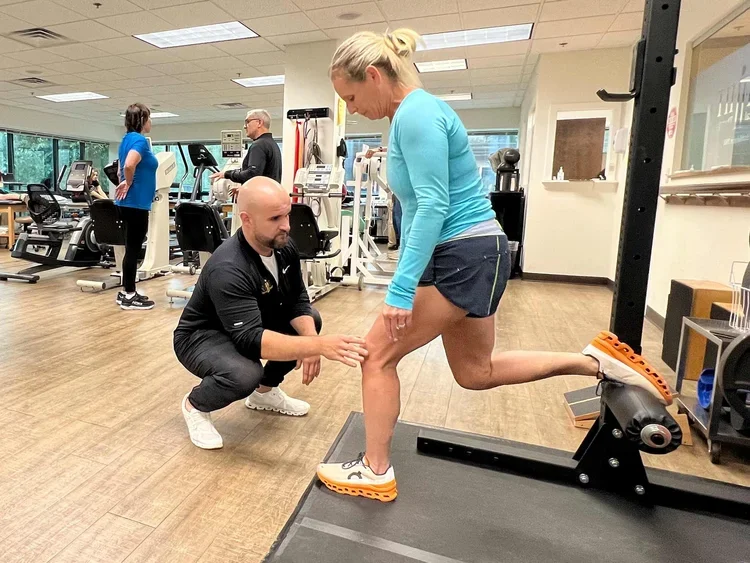
At Summit Physical Therapy, we use our Return-to-Activity Roadmap to guide rehabilitation. The idea is simple: to get back to the activities you enjoy, we build your knee from the bottom up.
Step 1: Reduce Pain and Swelling
First, we figure out what makes your knee feel worse—and what makes it feel better.
Maybe deep squatting bothers it. Maybe it swells after pickleball. Maybe you’re fine walking for 20 minutes but hurt after an hour.
By identifying these aggravating and easing factors, we can modify your activity without unnecessarily stopping everything you enjoy. Often, getting the irritation and swelling under control can quickly improve how the knee feels and moves.
Step 2: Restore Motion
Pain and swelling can make a knee stiff, so motion often improves as the knee calms down.
If stiffness remains, we use targeted exercises and hands-on treatment to restore it. Being able to fully straighten your knee is especially important.
We may also address hip or ankle mobility if restrictions there are affecting how you move.
Step 3: Improve Control
Next, we work on how well you control your leg.
This may start with something as simple as getting your quadriceps to work normally again. From there, we progress to controlling the knee during more challenging movements.
The goal is to help your hip, knee, and foot work together instead of allowing unnecessary twisting or side-to-side movement at the knee.
Step 4: Build Strength
Quadriceps strength is one of our biggest priorities with meniscus injuries.
We also strengthen the hips, hamstrings, calves, and other muscles that help control the leg.
As you get stronger, we incorporate that strength into movements you actually use: squatting, lunging, stepping up, stepping down, pushing, pulling, and single-leg activities.
Step 5: Build Speed, Power, and Endurance
If your goals are more athletic, getting strong isn’t the finish line.
Your knee may also need to tolerate faster and more demanding movements like running, jumping, landing, cutting, and changing direction.
Eventually, we need to build endurance too. Performing a movement correctly once is very different from maintaining it late in a run, hike, or tennis match when you’re tired.
Step 6: Get Back to What You Love
The final step is returning to your activity.
That could be running, hiking, skiing, golf, tennis, pickleball, cycling, strength training—or simply being able to stay active without constantly thinking about your knee.
Your rehabilitation should eventually look like the activity you’re trying to return to.
A tennis player needs to cut and change direction. A runner needs to tolerate repeated impact. A hiker needs strength and endurance for hills.
Getting rid of pain is only part of the goal. We want your knee prepared for what you’re asking it to do.
So, Can Physical Therapy Help You Avoid Meniscus Surgery?
For many people, especially adults with degenerative meniscus tears, physical therapy can be an appropriate first treatment before considering surgery.
That doesn’t mean surgery is never necessary. Certain acute traumatic tears, a knee that is truly locked and unable to straighten, or symptoms that don’t improve with appropriate rehabilitation may require further orthopedic evaluation.
The goal isn’t to avoid surgery at all costs. It’s to determine whether you actually need it.
Your MRI Is Only Part of the Story
Instead of looking only at the meniscus tear, we look at your entire Return-to-Activity Roadmap:
Pain & Swelling → Motion → Control → Strength → Functional Movement → Power & Endurance → Return to Activity
Your MRI tells us what your knee looks like.
Our roadmap helps us understand what your knee can do—and what we need to improve to get you back to doing what you love.
Physical Therapy for Meniscus Tears in Summit, NJ
At Summit Physical Therapy, we help active adults throughout Summit, Short Hills, Millburn, Chatham, Madison, Florham Park, Maplewood, and surrounding New Jersey communities recover from knee injuries and return to the activities they enjoy.
If you’ve been diagnosed with a meniscus tear and aren’t sure whether surgery is your next step, schedule an evaluation with Summit Physical Therapy.
We’ll identify where you’re limited in your Return-to-Activity Roadmap and build a plan to help you move forward.