
Hip Labrum Rehab for Athletes: What High-Level Rehabilitation Should Include
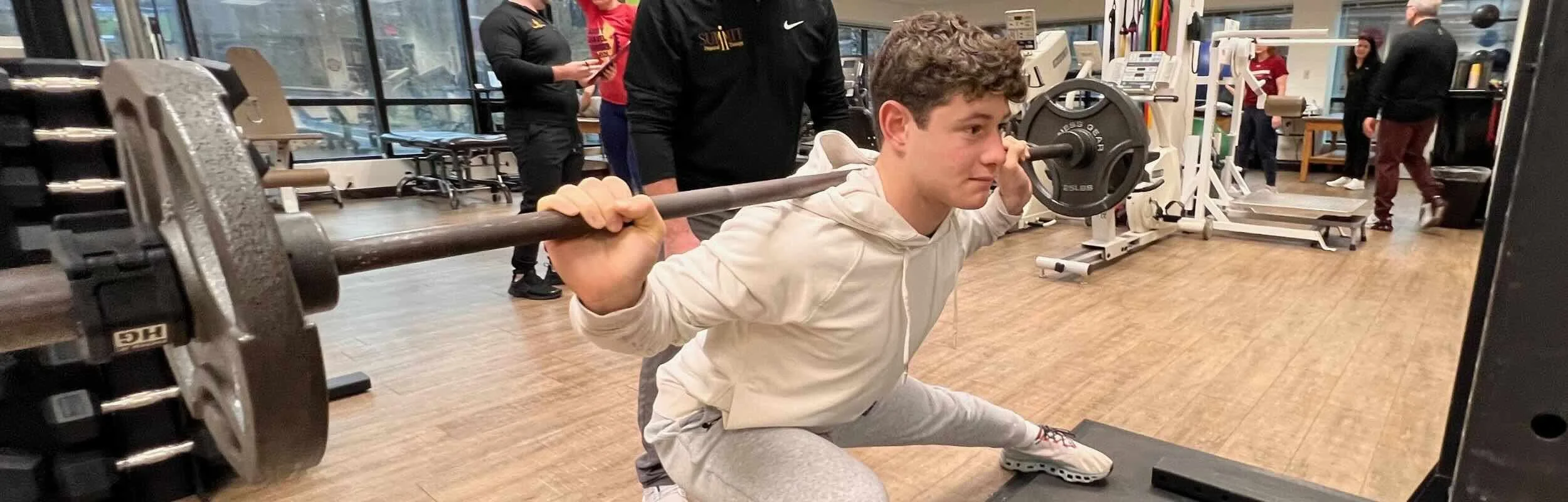
A hip labral injury can be frustrating for an athlete. You may be able to lift, run, skate, cut, or practice—but not at full speed, not without symptoms, or not with confidence.
The goal of rehabilitation should not simply be to make your hip feel better during everyday activities. It should prepare your entire body for the strength, speed, power, and repeated demands of your sport.
At Summit Physical Therapy, we treat athletes with hip labral injuries using a progressive, objective approach. Whether you are trying to avoid surgery or return after a hip labral repair, every phase should build toward the demands you will face in training and competition.
What Is a Hip Labral Injury?
The labrum is a ring of cartilage around the hip socket that helps create stability and distribute force through the joint. An irritated or torn labrum may cause:
Pain in the front of the hip or groin
Pinching with deep squatting or hip flexion
Pain with running, cutting, pivoting, or kicking
Clicking, catching, or a sense of instability
Reduced hip mobility
Difficulty producing force through one leg
An MRI finding does not tell the entire story. Some athletes have labral changes without symptoms, while others are significantly limited. A high-level evaluation must determine which movements and training loads irritate the hip—and which physical deficits are preventing it from tolerating sport.
High-Level Hip Labrum Rehab Is More Than Hip Exercises
The hip does not work by itself. Trunk control, pelvic position, hip mobility, adductor and glute strength, lower-leg capacity, and the athlete’s ability to absorb and produce force can all influence hip loading.
That is why a generic sheet of band exercises is rarely enough for an athlete. Your program should progress from symptom control to full-speed, sport-specific performance.
Phase 1: Reduce Pain and Irritation Without Losing Fitness
The first step is identifying aggravating and easing factors. Deep hip flexion, high running volume, heavy squatting, cutting, or prolonged sitting may need to be temporarily modified.
The answer is not always complete rest. We look for ways to maintain conditioning and train the rest of the body while reducing the specific loads that keep the hip irritated. Hands-on treatment may also be used when it helps reduce pain or improve motion, but it should support an active rehabilitation plan.
Phase 2: Restore the Mobility the Athlete Actually Needs
Hip flexion, rotation, and extension should be assessed alongside the pelvis, lower back, knee, and ankle. The goal is not to force every athlete into the same mobility standard. It is to restore the motion required for that athlete’s anatomy, symptoms, and sport.
Forcing an irritable hip repeatedly into a painful pinch is not effective mobility work. We build usable range of motion gradually and then teach the athlete to control it.
Phase 3: Rebuild Control and Coordination
An athlete can have strong muscles on isolated testing and still struggle to control the hip during a single-leg squat, landing, stride, or change of direction.
This phase may address:
Pelvic and trunk control
Single-leg balance and stability
Coordination of the glutes, adductors, hip flexors, and deep hip muscles
Control during acceleration, deceleration, rotation, and landing
The exercises should become progressively faster and more specific as symptoms and capacity improve.
Phase 4: Develop Measurable Strength
Athletes need more than exercises that simply “feel challenging.” We measure hip and lower-extremity strength using VALD testing technology and compare performance with the opposite side, prior testing, and appropriate reference data.
Testing can identify deficits in hip extension, abduction, adduction, rotation, and other key muscle groups that may be missed by visual assessment alone. These results help us prescribe the right intensity and determine whether the athlete is truly progressing.
Strength work may include heavy bilateral and single-leg patterns, targeted hip loading, and exercises for the trunk, knee, and lower leg. The exact program depends on the athlete’s sport and current limitations.
Phase 5: Restore Functional Strength and Power
Being strong slowly does not automatically mean you can produce or absorb force quickly. Power is a critical bridge between strength and athletic performance.
As the hip becomes more tolerant, rehabilitation should progress to faster squats, split-stance patterns, step-ups, jumps, bounds, medicine-ball work, and acceleration drills when appropriate. The athlete must be able to generate force without losing trunk or pelvic control.
Phase 6: Progress Plyometrics and Change of Direction
Progress To Perform
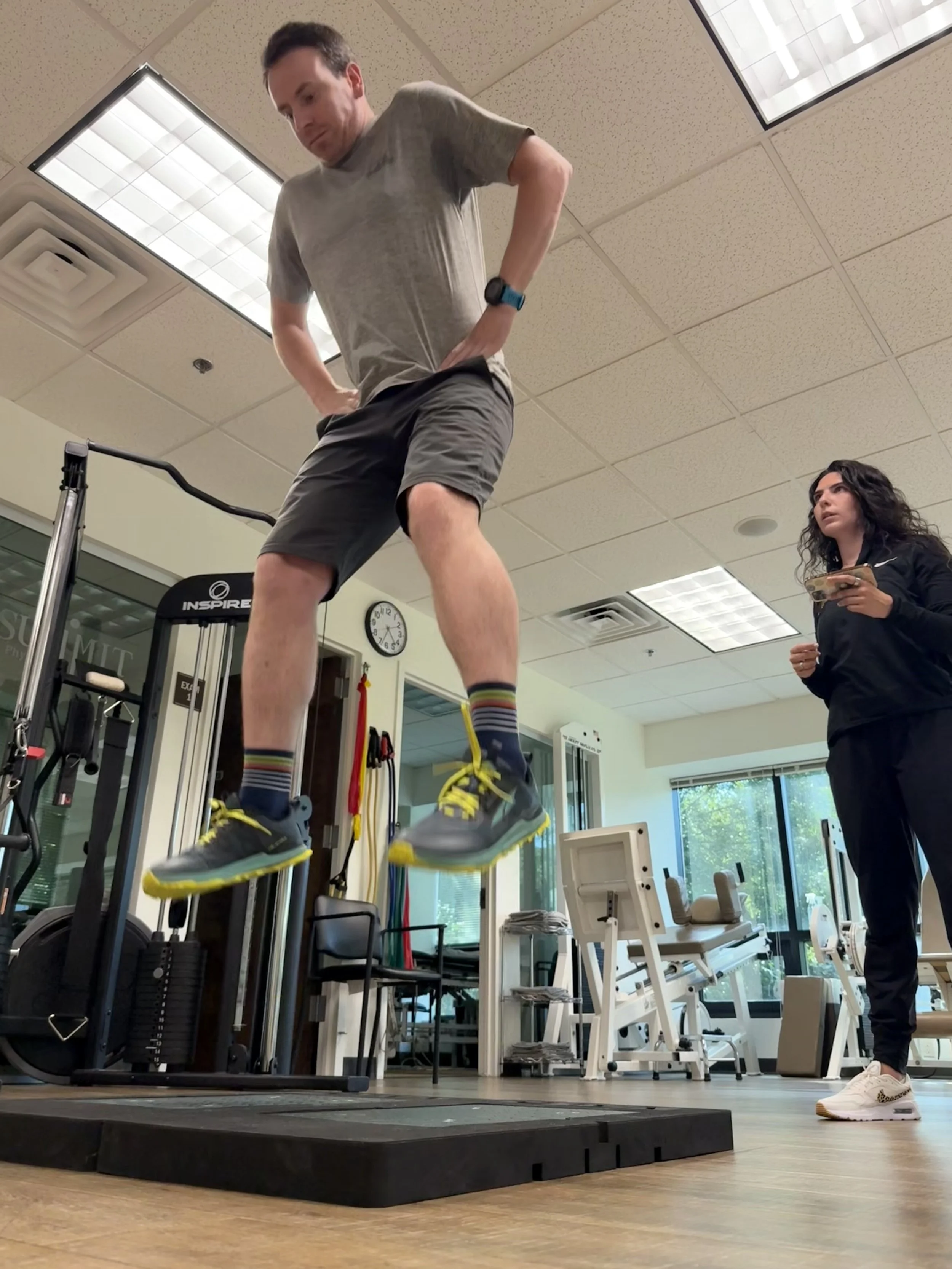
We use VALD ForceDecks to assess qualities such as force production, landing strategy, asymmetry, and rate of force development when appropriate. This gives us objective information that cannot be obtained by simply watching an athlete jump.
Running, field sports, court sports, and many lifting activities expose the hip to forces that basic strengthening cannot reproduce. Jumping, landing, cutting, pivoting, and decelerating should be introduced progressively—not saved for the final visit.
Phase 7: Build Endurance and Durability
Passing one strength or jump test does not guarantee that the hip can tolerate an entire practice, long run, tournament, or training week.
Rehabilitation must build volume gradually. We monitor how the hip responds during the session, later that day, and the following day. Running distance, sprint exposure, cutting volume, lifting intensity, and practice participation are progressed based on the athlete’s response—not guesswork or a date on the calendar.
Phase 8: Return to Sport With Objective Criteria
The final stage should reproduce the positions, speeds, fatigue, and decision-making demands of your sport. A runner needs repeated loading tolerance. A field or court athlete needs acceleration, deceleration, and multiplanar change of direction. A strength athlete must tolerate deep positions and heavy force production.
Return-to-sport decisions may consider:
Symptoms during and after training
Hip and lower-extremity strength testing
Jump and force-plate performance
Change-of-direction quality and tolerance
Training volume and recovery
Confidence at full speed
Time since injury or surgery matters, but time alone does not prove readiness.
What Makes Summit Physical Therapy Different?
Our approach combines detailed clinical assessment, one-on-one decision-making, progressive strength and conditioning, and objective performance testing. We do not use aides or technicians to supervise your rehabilitation. Your physical therapist remains responsible for your plan of care and progresses it based on your testing, symptoms, goals, and sport.
Our goal is not to discharge you as soon as you can complete basic exercises. It is to help you understand your hip, rebuild the qualities your sport requires, and return with measurable evidence that your body is prepared.
Looking for Advanced Hip Labrum Rehab in New Jersey?
If hip pain or a labral injury is keeping you from training at your best, Summit Physical Therapy can help you build a clear path back to sport.
We work with athletes from Summit, Short Hills, Millburn, Maplewood, Chatham, Florham Park, New Providence, Springfield, South Orange, and surrounding New Jersey communities.
Schedule an evaluation with Summit Physical Therapy to find out what is limiting your hip and what it will take to return to your sport.