

Advanced ACL Rehab. Objective Testing. Confident Return to Sport.
An ACL injury can be a major setback, but the right rehabilitation can help you return stronger, more confident, and better prepared for the demands of your sport.
At Summit Physical Therapy, we specialize in advanced ACL rehabilitation for athletes and active individuals recovering from ACL reconstruction, non-operative ACL injuries, and ACL tears.
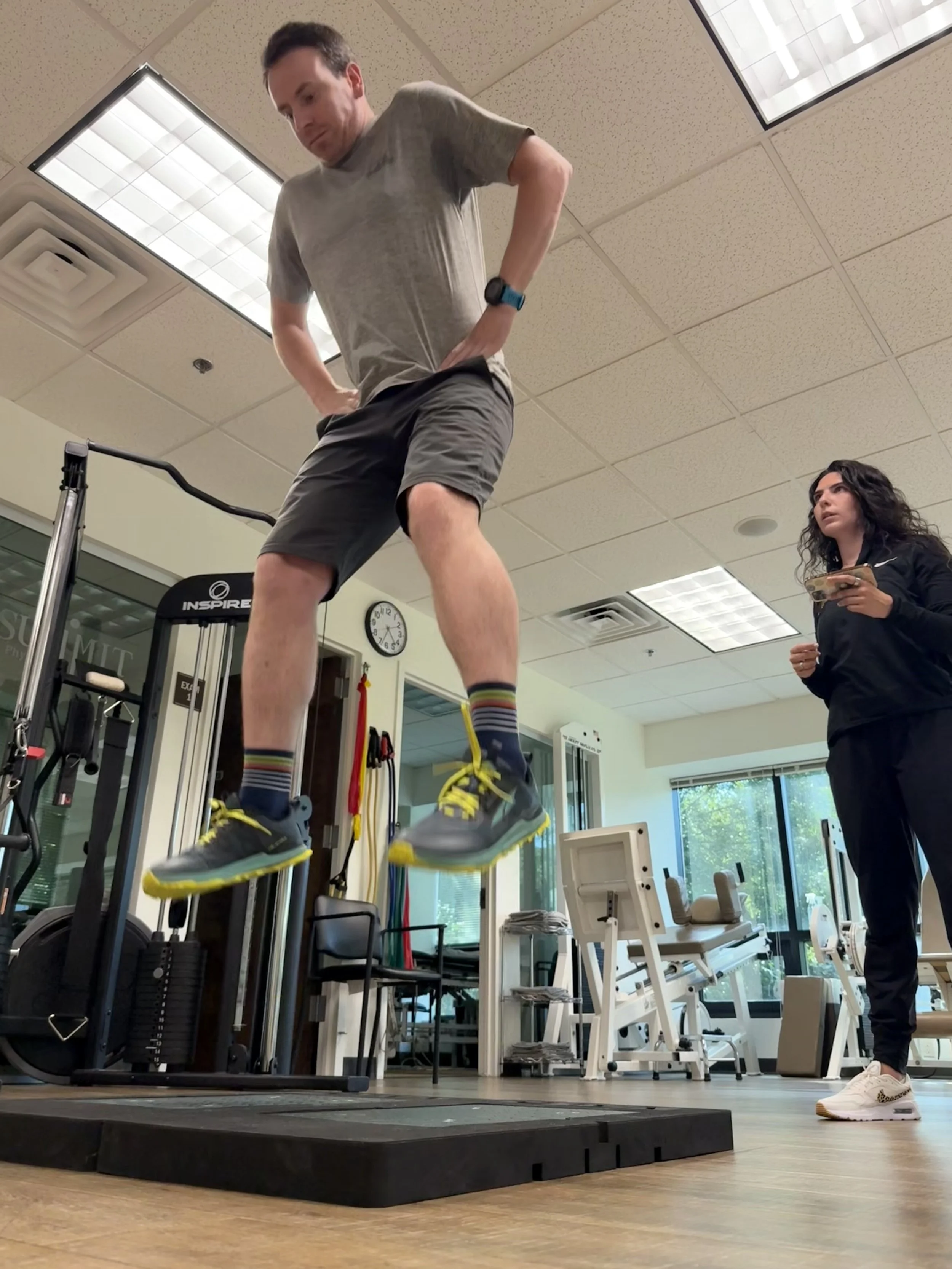
Test What Matters
Our approach goes beyond simply following a post-operative protocol. We use VALD strength testing and ForceDecks force plates to objectively measure strength, power, jumping, and landing performance throughout your recovery.
The goal isn't just to get you through ACL rehab.
It's to make sure you're physically prepared for what you want to return to.
Schedule an ACL Evaluation
Why Choose Summit Physical Therapy for ACL Rehab?
ACL rehabilitation should be based on more than how many months have passed since surgery.
Two athletes who are both six months after ACL reconstruction can have very different levels of quadriceps strength, power, movement quality, and readiness to return to sport.
Our ACL rehabilitation combines:
Individualized ACL rehabilitation based on your specific injury, surgery, sport, and goals
VALD strength testing to objectively measure quadriceps and lower-body strength
VALD ForceDecks force plate testing to measure jumping, landing, power, and differences between legs
Progressive strength and athletic development
Running, jumping, plyometric, and change-of-direction training
Objective return-to-sport testing
Sport-specific rehabilitation designed around what you actually need to return to
We don't want to guess whether you're getting stronger.
We measure it.
Our ACL Rehabilitation Progression
Every ACL injury is different, but successful rehabilitation generally follows a progression from restoring basic knee function to rebuilding athletic performance.
1. Reduce Pain and Swelling
Early ACL rehabilitation focuses on protecting the knee while reducing pain, swelling, and inflammation.
We identify aggravating and easing factors, modify activity appropriately, and use exercise and hands-on treatment when indicated to help restore normal knee function.
Controlling swelling is particularly important because an irritated, swollen knee can make it much harder to properly activate and strengthen the quadriceps.
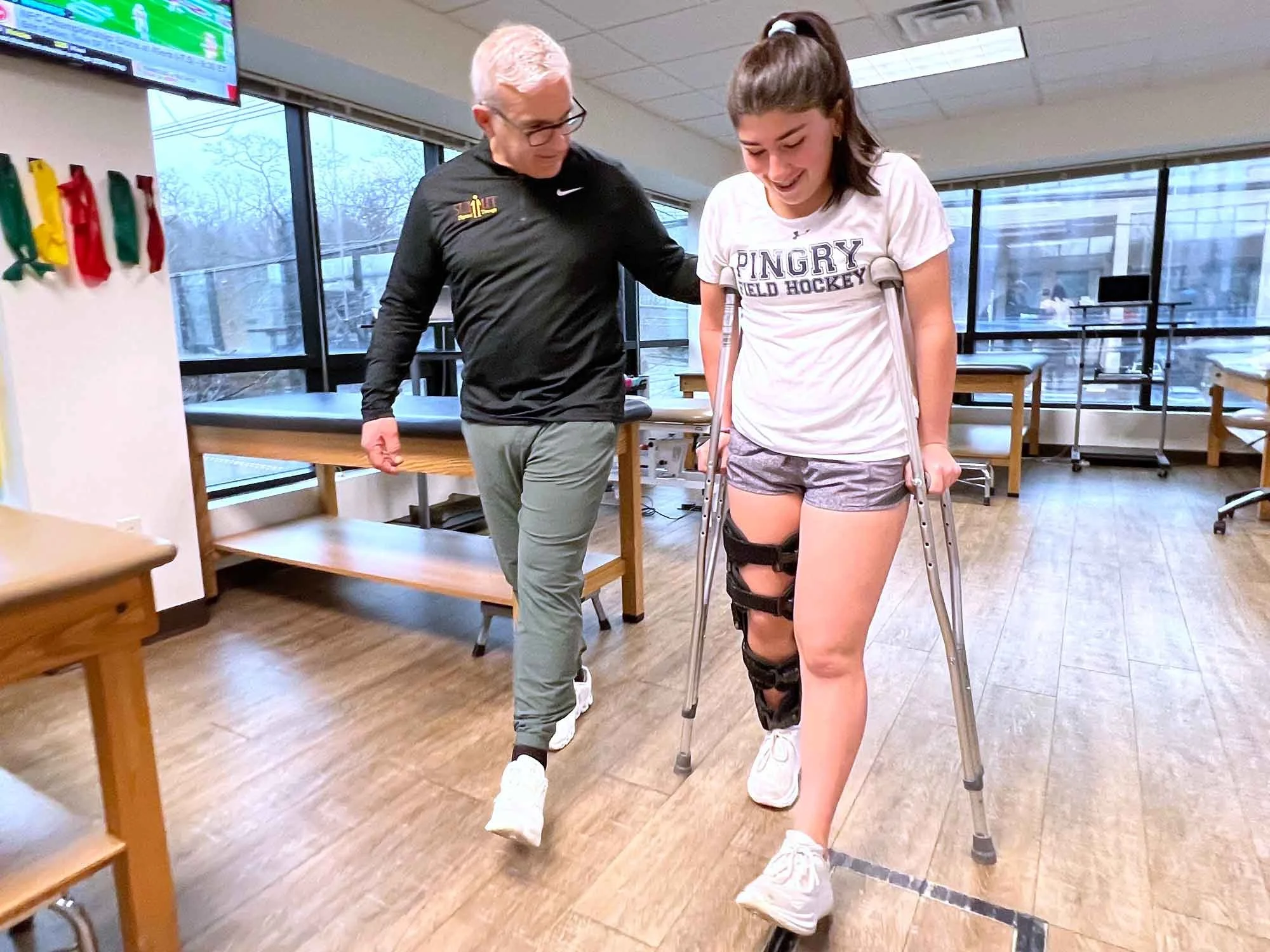
Get Walking Early
When Rehab is managed well early, function comes fast.
2. Restore Full Range of Motion
Regaining normal knee motion is one of the most important early goals after an ACL injury or reconstruction.
Particular attention is placed on restoring the ability to fully straighten the knee, while progressively restoring knee flexion.
We also evaluate mobility at the hip and ankle to make sure limitations elsewhere aren't affecting how you move.
3. Restore Neuromuscular Control
Once motion improves, we work on restoring normal control of the recovering leg.
This includes progressively challenging balance, coordination, single-leg control, squatting, stepping, and other movements that become the foundation for more advanced athletic activity.
4. Rebuild Quadriceps and Lower-Body Strength
Quadriceps strength is one of the most important components of ACL rehabilitation.
But ACL rehab shouldn't stop with the quadriceps.
We also progressively strengthen the hamstrings, glutes, hips, calves, and trunk so the entire lower body can produce and absorb the forces required for running, jumping, landing, and changing direction.
This is where objective testing becomes especially important.
VALD Strength Testing for ACL Rehabilitation
A patient can look strong during an exercise while still having a meaningful strength deficit in the recovering leg.
That's why we use VALD strength testing technology throughout ACL rehabilitation.
Depending on your stage of recovery, we can objectively measure:
Quadriceps strength
Hamstring strength
Hip strength
Calf strength
Differences between the recovering and uninvolved leg
Testing gives us actual numbers that we can track throughout your rehabilitation.
If a deficit remains, we can identify it and adjust your program accordingly.
If you've made significant progress, we can demonstrate it objectively and determine what you are ready to work on next.
ACL rehab shouldn't be based on guesswork.
5. Build Functional Strength
Once adequate foundational strength has been restored, rehabilitation progresses toward more demanding functional patterns.
Exercises become heavier, faster, and increasingly specific to your goals.
For an athlete, that may include progressively loaded squatting, lunging, single-leg strengthening, deceleration, and other movements that prepare the body for running and jumping.
6. Develop Power
Being strong doesn't automatically mean you're ready for sports.
Athletes need to produce force quickly.
We progressively train lower-body power so the recovering leg can handle the faster demands of running, jumping, sprinting, and athletic movement.
Power becomes increasingly important as we transition from traditional rehabilitation toward athletic performance.
VALD Force Plate Testing After ACL Reconstruction
Later in ACL rehabilitation, we want to know more than whether you can perform a jump.
We want to know how you're performing it.
Summit Physical Therapy uses VALD ForceDecks force plates to objectively evaluate jumping, landing, and lower-body performance.
Depending on the athlete and stage of rehabilitation, force plate testing can help us assess:
Lower-body power
Force production
Differences between legs
Jump performance
Landing strategy
Force absorption
Changes in performance throughout rehabilitation
This is important because an athlete can appear symmetrical while still subconsciously relying more heavily on the uninvolved leg.
Force plates allow us to identify differences that aren't always visible to the eye.
7. Plyometrics and Change of Direction
Once adequate strength and power have been established, rehabilitation progresses to faster and more reactive movements.
This can include:
Jumping and landing
Single-leg plyometrics
Acceleration and deceleration
Cutting
Change of direction
Reactive athletic movements
The progression depends on your sport and your individual goals.
A soccer player, skier, basketball player, tennis player, and recreational runner shouldn't all finish ACL rehabilitation with the exact same program.
8. Build Endurance and Durability
Passing a strength or jump test is important, but athletes also need to maintain their performance when they become tired.
As you approach the end of rehabilitation, we progressively increase training volume and conditioning so your knee can tolerate the repeated demands of practices, games, workouts, and everyday activity.
9. Return to Sport and Activity
The final phase is specific to you.
We progressively expose you to the movements, speeds, loads, and demands required for your sport or activity.
The goal is to bridge the gap between traditional physical therapy and actually being ready to perform.
How Do You Know When You're Ready to Return to Sport After ACL Surgery?
Time after ACL reconstruction is important, but time alone does not determine readiness for sport.
Before returning to higher-level activity, we want to evaluate factors including:
Knee range of motion
Quadriceps strength
Lower-body strength
Neuromuscular control
Power
Jumping and landing ability
Change-of-direction ability
Endurance and durability
Confidence in the recovering knee
Our VALD strength testing and ForceDecks testing give us objective information that we combine with your clinical examination, rehabilitation progress, and the specific demands of your sport.
Instead of only asking:
"Has enough time passed?"
We also ask:
"Is your knee actually prepared for what you're about to ask it to do?"
Who Can Benefit From Our ACL Rehabilitation Program?
Our ACL physical therapy program can help:
Athletes recovering from ACL reconstruction
Individuals pursuing non-operative ACL rehabilitation
Patients preparing for ACL surgery
Athletes who feel stuck or behind during ACL rehab
Athletes who have completed basic physical therapy but aren't ready for sport
Athletes looking for objective ACL return-to-sport testing
Individuals looking to restore strength and confidence after an ACL injury
You don't necessarily have to begin your rehabilitation with us.
If you're several months into ACL rehab and want a more advanced assessment of your strength, power, jumping, or return-to-sport readiness, we can evaluate where you are and identify what may still need improvement.
ACL Injury Prevention and Performance Testing
You don't need to tear your ACL to benefit from strength and performance testing.
We also work with healthy athletes who want to identify areas of strength, power, landing performance, and movement that may be appropriate targets for training.
VALD testing allows us to use objective data to develop a more individualized strength and performance program rather than relying solely on a generic injury-prevention routine.
Frequently Asked Questions About ACL Rehabilitation
How long does ACL rehabilitation take?
ACL rehabilitation is a long-term process, particularly for athletes returning to cutting, pivoting, jumping, and high-speed sports. Your progression should depend on healing, strength, movement, performance testing, and the demands of your sport—not simply a predetermined calendar.
When can I start running after ACL surgery?
Running should generally begin when your knee has recovered enough motion, strength, control, and tolerance for impact. Rather than progressing solely because a certain number of weeks have passed, we evaluate whether your knee is physically prepared for the increased demand.
Why is quadriceps strength so important after ACL reconstruction?
The quadriceps play a major role in controlling the knee and producing and absorbing force. Significant quadriceps weakness can persist after ACL injury and reconstruction, which is why restoring and objectively measuring quadriceps strength is a major component of our ACL rehabilitation program.
What is ACL return-to-sport testing?
Return-to-sport testing evaluates whether an athlete has restored the physical qualities needed for their sport. At Summit Physical Therapy, this may include clinical assessment, strength testing, movement testing, jumping and landing assessment, and VALD ForceDecks force plate testing.
Can you test me if I'm doing ACL rehab somewhere else?
Yes. Athletes who are already in rehabilitation may benefit from additional objective strength and performance testing to better understand their current deficits and readiness to progress.
Can an ACL injury be treated without surgery?
Some ACL injuries can be managed non-operatively. The appropriate treatment depends on factors such as the nature of the injury, knee stability, associated injuries, symptoms, and the activities or sports you want to return to. We can work with you and your medical team to develop an appropriate rehabilitation plan.
Specialized ACL Physical Therapy Near Summit, NJ
Summit Physical Therapy provides advanced ACL rehabilitation for athletes and active individuals throughout Summit, Short Hills, Millburn, Maplewood, Chatham, Florham Park, New Providence, Springfield, and South Orange, New Jersey.
Whether you're preparing for ACL surgery, recovering from ACL reconstruction, pursuing non-operative rehabilitation, or trying to make the final transition back to sport, we'll help identify where you are, what you're missing, and what needs to happen next.
Don't Just Return. Be Ready.
ACL rehabilitation shouldn't end because you've reached a certain date on the calendar.
It should end when you've rebuilt the strength, power, movement, durability, and confidence necessary for the activities that matter to you.
Schedule an ACL evaluation at Summit Physical Therapy and find out where you are in your recovery.
Reach out today to find out how Summit Physical Therapy can help with your ACL symptoms!
